Blogs
Articles

How to Build AI Agents That Actually Scale: A Step-by-Step Guide for 2026
A remarkable 90% of businesses report better workflows after adopting AI agents. Building AI agents has become more than a technical challenge - businesses need it to stay competitive.
The AI agent market will grow beyond $50 billion by 2030, and agentic AI will become commonplace by 2026. This represents a fundamental change in technology adoption. Recent studies show that 96-98% of IT leaders will expand their AI agent usage next year. Most organizations aim for complete deployment rather than small pilot projects, with 78% planning company-wide implementation.
These statistics tell a compelling story. Enterprise software applications will see a dramatic increase in agentic AI capabilities - from less than 1% in 2024 to 33% by 2028. AI agents will handle 80% of common customer service queries without human help by 2029. This change will reduce operational costs by 30%.
This piece provides a practical, step-by-step approach to build scalable AI agents for your organization. We have useful strategies and proven methods for 2026 and beyond, whether you're new to AI or expanding your current systems.
A Step-by-Step Guide to Building AI Agents
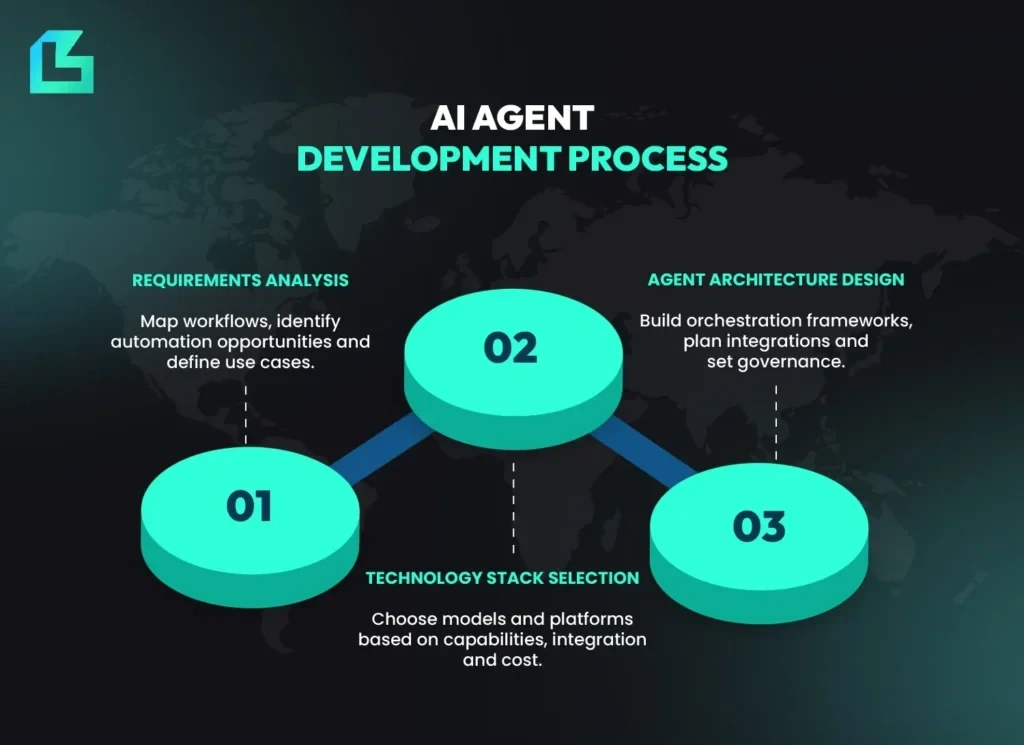
AI agents need more than just coding skills to scale well—you need a well-laid-out approach. Here's how to create AI agents that add real value.
Planning Your AI Agent
Your first step is to define what your AI agent will do and how far it will go. The path to success starts when you set clear goals that match what your business needs. Deloitte's research shows that companies find real value when they redesign operations instead of just adding agents to their current workflows. You should work with stakeholders to verify your project's purpose and figure out the internal data you'll need before you start development.
Choosing the Appropriate Tools and Technologies
The right frameworks and platforms play a significant role in success. LangGraph works well for stateful workflows and persistent memory, while CrewAI helps with role-based cooperative agents. Agent SDK lets you build tool-enhanced agents. Your choice should depend on your team's expertise, how complex the development will be, and what you need to integrate. New developers might want to try no-code platforms like Zapier AI, n8n, and MindStudio for quick prototyping.
Designing the AI Agent Architecture
A good agent design has several key parts: a reasoning engine (usually an LLM), memory systems that keep context, and tool interfaces for outside connections. IBM notes that AI agent planning works with perception, decision-making, and learning modules to help agents reach their goals. Complex workflows might need multi-agent systems where multiple coordinated agents handle tasks together.
Developing the AI Agent
The development phase works best when you build step by step and test each feature. Your agent will need clean, labeled, and current high-quality data. The documentation shows that AI agents perform better with current data, which leads to better user experiences. Your specific case might need neural networks ML or reinforcement learning models for training.
Deploying Your AI Agent
You can deploy your agent in four main ways:
Batch deployment for scheduled automation and throughput optimization
Stream deployment for continuous data processing
Real-time deployment for instant interaction via API
Edge deployment for privacy-first applications running directly on user devices
Business users can check out Persana AI for specialized enterprise solutions.
Training and Optimizing Your AI Agent
Success metrics should track task completion rates, response accuracy, and resource use. Your agent needs constant monitoring to keep performing well. Regular evaluations help you spot ways to improve and measure up against industry standards.
Security and Ethical Considerations
Strong security and ethical guidelines must be in place. Your organization should create clear AI policies that address agent systems and their risks. You'll need backup plans ready for when agents fail or act unexpectedly, including ways to shut them down and alternative solutions.
Using vulnerability scanning tools can help detect potential weaknesses in your AI agents’ code and infrastructure, ensuring they operate securely and reliably
AI Agent Development: Common Challenges and Solutions
Adaptable AI agents face major challenges during development. Current autonomous agent systems work successfully only half the time. Their failures spread through planning, execution, and response generation.
Poor data quality creates the biggest problem. AI leaders (43%) point to data readiness as their main challenge. AI agents produce incorrect answers and poor user experiences without clean, diverse datasets. The solution requires relevant data collection and strong governance practices from the start.
There's another reason why these projects fail - technology doesn't line up with business goals. By 2027, organizations will abandon nearly 40% of agentic AI projects that fail to show business value. Success depends on clear KPIs that connect to specific business problems rather than pursuing technical capabilities alone.
Security remains a top concern. Data privacy and compliance issues worry 62% of practitioners. Successful companies use strong authentication protocols and audit their vulnerabilities. They also test how agents handle manipulations.
AI agents often struggle to communicate with existing systems. Many businesses face compatibility issues between AI tools and older infrastructure. Flexible APIs and middleware solutions enable uninterrupted connections without disruption.
Systems that work well in controlled environments often stumble under ground demands. This creates scalability barriers. Cloud-based solutions that adjust to changing needs help build AI infrastructure ready for growth.
Only when we recognize these challenges and implement targeted solutions can we develop AI agents that deliver consistent, valuable results at scale.
Persana AI Agents for Real Business Problems
Persana AI builds expandable agent solutions that work for many industries. They tackle real business problems instead of just showing off fancy technology.
Their agents stand out because they get results. These solutions merge with your current business systems. Your team can use them right away without changing how they work. The platform creates custom agents that match what each organization needs. They can handle everything from complex customer conversations to making internal tasks more efficient.
The system lets you run single agents or multiple agents that work together. Companies can start small and grow when they need to. Every agent is built to expand easily, so it works just as well whether you have ten users or ten thousand.
You can plug the platform into common business systems quickly. This makes setup much faster than traditional development methods.
The company helps businesses that want to use AI agents in practical ways. They create custom plans based on what you want to achieve. Their platform gives you everything needed to run enterprise-level AI without requiring your team to become technical experts.
Visit persana to see how these specialized AI agents can solve your business challenges.
Conclusion
AI agents that can grow with your business offer more than just a tech experiment. They bring real value. Companies that put these systems to work see big improvements, with 90% reporting better workflows. These agents are revolutionizing how businesses talk to customers, run their processes, and make sense of complex data.
This piece lays out a clear path for businesses at any point in their AI development. Your success depends on good planning, the right tools, and smart design choices. The focus should stay on fixing real business problems rather than just adding tech for its own sake.
The biggest problems in getting AI agents to work come from bad data, goals that don't match business needs, and systems that don't work together well. Smart planning and targeted fixes can solve these issues. As your AI gets better, security and ethics need constant attention.
Businesses need practical, ready-to-use AI solutions. Persana AI meets these needs with custom agents that blend into your current setup and deliver real value. You can find solutions that fit your needs at persana.
Smart systems will shape how businesses work in the future. What you do now will decide if you lead or follow tomorrow. Start small, pick projects that matter most, and grow as you verify results. Moving to AI agents might look tough, but companies that start now will end up leading their industries.
FAQ
How are AI agents built?
Three key components make up AI agents: an LLM for reasoning and decision-making, tools (external functions or APIs), and explicit instructions that define behavior. Developers collect data, select models, train them, and test before deployment. Quality data preparation, proper model training, and extensive testing are crucial for building effective agents.
What is the best platform to build AI agents?
Your specific needs determine the best platform choice. Enterprise users benefit from Vertex AI Agent Builder and Salesforce Agent Builder with their built-in governance features. Botpress, Gumloop, and FlowiseAI give you user-friendly options for quick prototyping. The right choice depends on your tech stack integration, LLM model support, and security needs.
What is the best framework for AI agent?
Experienced developers often choose LangChain for its flexibility. AutoGen stands out for multi-agent collaboration, while CrewAI works best for role-based systems. Your team's technical expertise, integration needs, and use cases should guide your framework choice. The framework you pick shapes how fast you can develop and what your agent can do.
How to create your own AI agent?
Define your agent's purpose and tasks first. Get high-quality data ready and pick the right model. Build your agent with code-based frameworks or no-code platforms. Run user tests and make improvements based on feedback. The final steps involve deployment and setting up systems to track performance.
Can I build AI agents without coding?
Yes! V7 Go and similar no-code platforms work like "smart spreadsheets" where you write tasks in plain English. Botpress, Gumloop, and Vertex AI let you build AI agents visually without coding skills. Complex enterprise projects might need some technical knowledge for customization.
How much to create an AI agent?
The price tag changes based on what you need. Basic prototypes cost between $2,000-$10,000, while mid-range solutions for SMEs run $15,000-$50,000. Enterprise AI agents start at $100,000+. No-code solutions cost less, with monthly plans ranging from free to $200+ for professional features. Your budget should include both development and running costs.