Blogs
Articles

How to Prioritize B2B Sales Leads: A Proven System That Actually Works
Research shows that 65% of businesses struggle with generating traffic and leads as their biggest marketing challenge. The numbers tell an interesting story - 80% of new leads never convert into sales.
The situation gets more concerning. Companies consistently qualify leads only 39% of the time, which leaves 55% of leads untouched. This pattern repeats in the B2B space where companies pour money into lead generation but can't prioritize sales prospects effectively. Most organizations lack a well-laid-out approach to qualify B2B leads.
Here's the bright side. Companies that master lead segmentation achieve 20% higher sales productivity. They generate 208% more revenue from marketing efforts compared to those using simple demographic segmentation alone. Businesses see transformative results after implementing a thorough lead scoring and prioritization process.
This piece reveals our proven system to prioritize B2B sales leads. Our approach substantially increases conversion rates and helps focus your efforts on revenue-generating opportunities. Your lead management will transform from chaotic to strategic!
Define and Segment Your Leads
Let's understand the fundamentals of lead prioritization and segmentation that are the foundations of any successful B2B sales strategy before we explore scoring systems and automation tools.
What is lead prioritization?
Lead prioritization helps teams evaluate and rank sales leads based on their potential value and conversion likelihood. Sales teams separate quality leads from unnecessary ones to focus on prospects with the highest chance of becoming customers. This approach helps sales representatives use their time, efforts, and resources better while targeting the most promising leads.
Why not all leads are equal
B2B lead generation comes with a harsh reality. Around 80% of new leads never translate into sales. Despite this fact, 54% of marketers claim that increasing lead volume is their main goal. Mass-generated contacts end up diluting your lead pool.
The main difference lies in understanding that genuine leads have an activity context, while simple contacts do not. Clicks don't always mean leads, and leads don't always convert to sales. Some prospects are ready to buy right away, while others might never convert despite your best efforts.
How to identify and segment B2B leads?
Your ideal customer profile (ICP) - attributes describing your perfect customer - should be the starting point for lead segmentation. You can then segment leads across multiple dimensions:
Firmographic data: Industry, company size, location, and revenue
Behavioral data: Website visits, content involvement, and email interactions
Intent signals: Research behaviors and keywords suggesting buying interest
Buying stage: The prospect's position in their purchase experience
Most organizations use a temperature-based classification system. They categorize leads as hot, warm, or cold based on sales readiness. Hot prospects want to purchase now, warm leads know your company's value, and cold leads have minimal awareness or need.
Proper segmentation enables tailored outreach that significantly improves conversion rates and helps sales teams focus on accounts that matter most.
Build a Lead Scoring System That Works
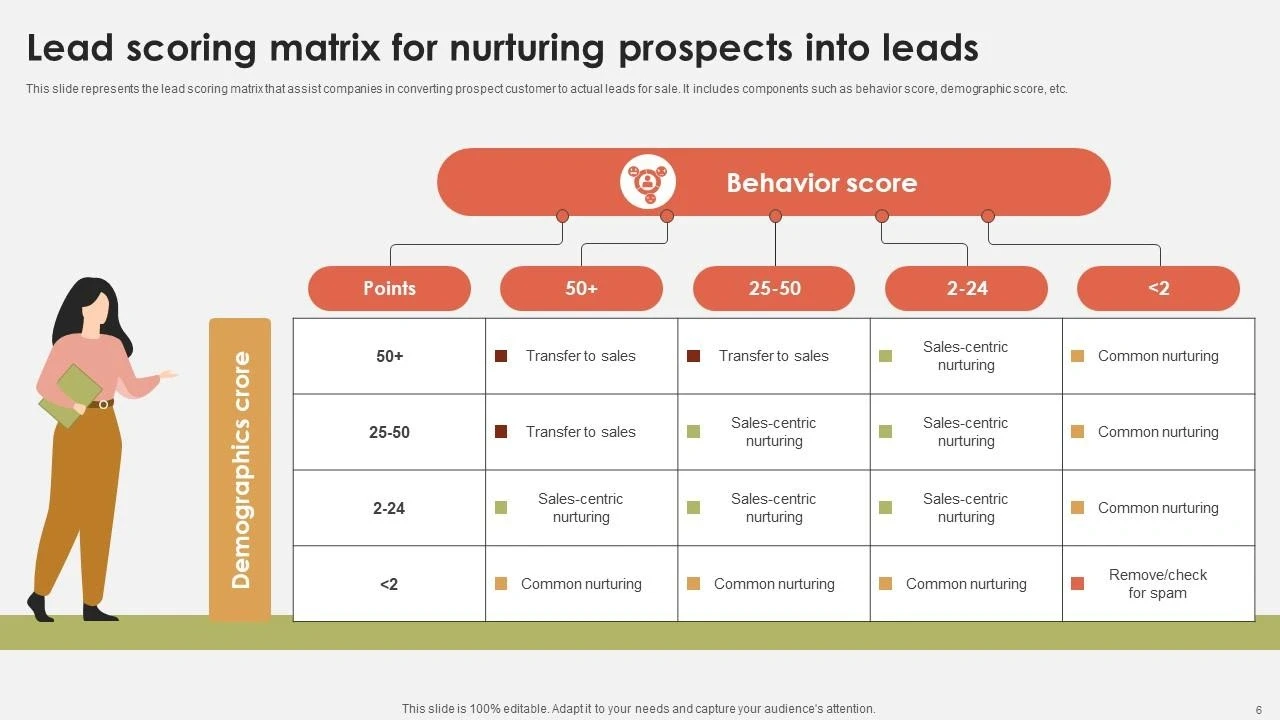
Building an effective scoring system comes next after identifying leads. Lead scoring models rank prospects on a 0-100 point scale based on their sales-readiness and business fit.
Use firmographic and behavioral data
Firmographic data are the foundations of your lead scoring model. Your model should include company details like size, industry, revenue, and location. Prospects who match your ideal customer profile (ICP) should receive higher points for these attributes. The model also tracks external triggers such as new leadership, mergers, or investments to enhance your firmographic scoring.
Behavioral data shows engagement patterns through:
Email interactions (opens, click-through)
Website activities (page visits, content downloads)
Social media participation (comments, shares)
These implicit indicators give stronger conversion signals than simple demographic information.
Assign scores based on engagement and fit
Point values should reflect both fit (right company match) and behavior (showing intent). This creates a dynamic scoring system that distinguishes researchers from serious buyers.
The system works best when you:
Map scoring criteria to buyer trip stages (Awareness → Consideration → Decision)
Set clear MQL and SQL thresholds
Add negative scoring for disqualifying actions
Your historical conversion data will reveal which actions predict sales success.
Incorporate intent signals and buying triggers
Intent data raises your scoring by spotting prospects who actively research solutions like yours. The most valuable signals include:
Multiple visits to pricing pages
Downloads of buyer's guides or competitive comparisons
Webinar attendance with post-event participation
Purchase triggers like funding rounds, leadership changes, or rapid hiring in GTM roles signal readiness to buy. These events create ideal moments to reach prospects when their interest peaks.
Note that Fit + Intent + Velocity = Confidence in conversion. The model needs review every 90 days to stay accurate as market conditions change.
Use Tools and Automation to Prioritize at Scale
Your scoring system needs technology to implement prioritization strategy at scale. The right tools can automate tedious tasks. They can also surface opportunities your team might miss otherwise.
CRM and lead routing tools
Modern CRM systems act as the backbone of effective lead management. They centralize data and streamline the prioritization process. Automated lead routing assigns leads to the right representatives based on territory, industry expertise, or account ownership. Companies that use lead routing software report up to 99% reduction in response time. This helps sales teams convert prospects faster by eliminating manual assignments.
Marketing automation for lead nurturing
Marketing automation platforms boost your nurturing strategy by delivering tailored content at each buying stage. About 95% of your target audience isn't ready to buy at any moment. This makes automated nurture sequences crucial to keep your brand relevant. These systems trigger timely follow-ups based on prospect behavior that give potential customers relevant information when they need it.
Email tracking and website behavior monitoring
Website visitor tracking tools revolutionize anonymous traffic into identifiable leads. They reveal which companies visit your site and what content engages them most. These platforms:
Identify companies through IP matching even when employees work remotely
Monitor specific page visits and time spent on site
Alert sales teams when target accounts demonstrate high intent
Predictive analytics and AI scoring
Advanced AI-powered scoring systems analyze thousands of data points to spot promising leads. Sales teams report 98% improved lead prioritization when using AI. These tools update scores live as new interactions occur. This removes subjectivity from the process. Persana offers an all-in-one solution that optimizes lead prioritization through advanced AI. Their proprietary scoring model assesses first-party intent signals against company research patterns to deliver genuinely sales-ready leads.
Why is it important to prioritize sales leads?
Lead prioritization is a vital component in today's competitive B2B market. To name just one example, see this revealing stat: a staggering 80% of new leads never convert into sales. This shows why treating all prospects equally doesn't work.
Companies that implement formal lead scoring see 138% ROI on lead generation compared to 78% for those without such systems. Organizations using machine learning for lead scoring report 75% higher conversion rates. High-performing companies achieve 6% conversion rates versus the industry average of 3.2%.
Quick response time plays a significant role. Companies that follow up within the first hour are nearly seven times more likely to qualify leads. Poor prioritization causes businesses to lose about 70% of prospects.
B2B sales cycles have grown 25% longer over five years, making smart resource allocation essential. Buyers complete 57% to 70% of their research before they contact sales. This makes identifying and focusing on high-potential prospects more important than ever.
Proper lead prioritization offers clear benefits. It streamlines processes, boosts conversion rates, optimizes resource use, shortens sales cycles, and grows revenue. These advantages have changed how B2B companies manage their sales pipeline.
What are the best ways to prioritize leads?
Your team should use organized methods to prioritize guides that are likely to convert. Successful sales organizations follow these proven methods:
Quick response to inbound guides works best responding in under five minutes makes you 100x more likely to connect and 21x more likely to convert prospects into opportunities. Your sales team should prioritize inbound guides first because they have showed clear interest in your solution.
Companies that use automated guide nurturing generate 50% more sales-ready guides at lower costs. Your prioritization sequence should be:
Prioritize warm inbound guides showing direct interest
Focus on prospects who interact with emails second
Target website visitors third (especially those visiting pricing pages)
Address good-fit outbound guides last
Signal-based selling dramatically improves conversion rates by identifying guides who show buying readiness through:
Content interactions with high-value assets
Organizational changes like new leadership
Funding rounds or company expansions
The most advanced prioritization systems employ a tiered approach. They categorize opportunities into action-based segments. Teams dedicate tailored outreach for high-value enterprise accounts while using automated nurture sequences for lower-priority prospects.
Tools like Persana make this process simple by automatically identifying and routing high-intent guides to your team.
Conclusion
B2B lead prioritization turns chaotic lead management into a strategic revenue-generating system. We've showed how proper lead scoring and qualification affect your bottom line. Successful organizations focus on lead quality and prioritization instead of chasing lead volume.
The data tells a compelling story. Companies with mature lead prioritization processes generate 208% more revenue and achieve 20% higher sales productivity. On top of that, it shows that organizations using AI-powered scoring systems report 75% higher conversion rates compared to industry averages.
Your next steps are straightforward. Define your ideal customer profile and segment leads based on firmographic and behavioral data. Build a scoring system that considers engagement levels and intent signals. Use automation tools to scale your prioritization efforts while you retain control of personalized outreach for high-value accounts.
Statistics show that responding to inbound leads within five minutes makes you 100x more likely to connect with prospects and 21x more likely to convert them into opportunities. Your prioritization system must balance speed with quality.
Many B2B companies have improved their sales results by using these proven prioritization strategies. Take the first step by evaluating your current lead management process. Identify gaps and implement the framework we've outlined. Your conversion rates will climb as your sales team focuses their efforts where they'll generate the most revenue.
High-performing sales teams excel because they know which leads deserve attention and when. Give your team this competitive advantage.
Key Takeaways
Master these proven strategies to transform your B2B lead management from chaotic to strategic and dramatically boost your conversion rates.
• Implement lead scoring with firmographic and behavioral data - Companies using structured scoring achieve 138% ROI versus 78% without systems
• Prioritize speed for inbound leads - Responding within 5 minutes makes you 100x more likely to connect and 21x more likely to convert
• Focus on quality over quantity - 80% of leads never convert, but mature prioritization processes generate 208% more revenue
• Leverage automation and AI tools - Organizations using machine learning for lead scoring report 75% higher conversion rates
• Segment leads by intent signals and buying triggers - Track pricing page visits, content downloads, and company changes to identify sales-ready prospects
The key insight? Stop chasing lead volume